How to hold a knife, and why your shallots are uneven
The pinch grip, the claw, and the three cuts that cover ninety percent of home cooking, explained by a fine-dining chef.
By Jarrett Kahler
Nobody teaches this. You pick up a knife at eight years old the way you'd pick up a hammer, and twenty years later you're still holding it that way, wondering why the onion slides around and the pieces come out in four sizes. Then the small pieces burn while the big ones are still raw, and you blame the recipe.
Two adjustments fix most of it. Neither takes talent. Both feel wrong for about a week.
The pinch grip
Don't hold the handle. Pinch the blade. Thumb on one side of the steel, just in front of the handle, the side of your curled index finger on the other. The remaining three fingers wrap the handle. You're holding the knife where it balances, which means the blade goes where your hand goes instead of wobbling at the end of a lever.
It feels precarious at first. It's the opposite. Every cook in every serious kitchen holds a knife this way, and it's the single biggest reason their cuts are even.
The claw
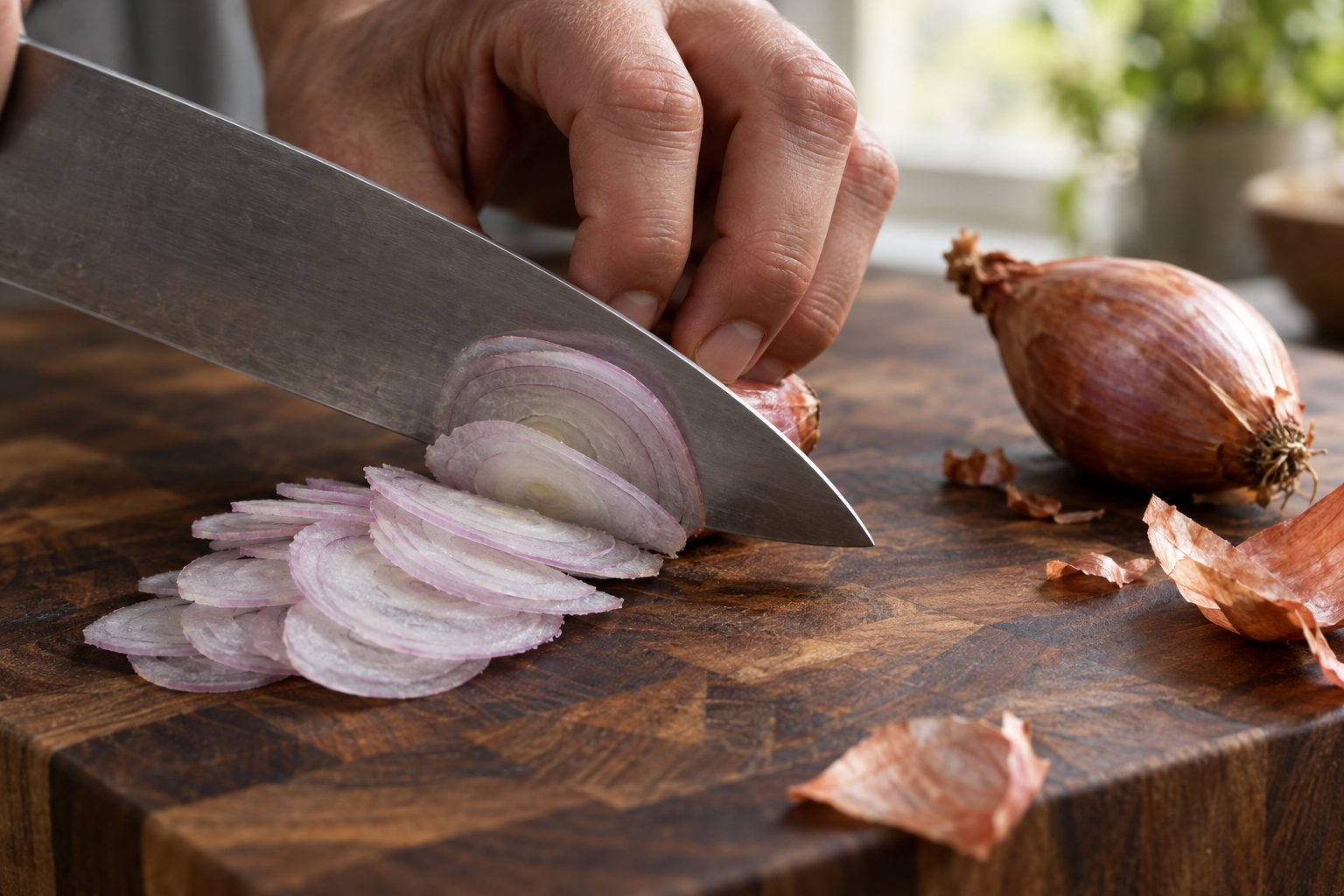
Your other hand is the guide. Curl the fingertips under, so your knuckles face the blade and the tips are tucked behind them. The flat of the blade rides against your knuckles. The blade physically cannot reach your fingertips because your knuckles are in the way, and every slice is the same width because your knuckles move back the same amount.
This is the one that feels wrong the longest. Keep doing it. After a week you'll stop thinking about it, and after a month you'll flinch watching someone cut with their fingers out flat.
The three cuts that matter
The slice
Tip of the knife stays on or near the board. The blade moves forward and down through the food in one motion, then back up. It's a push, not a chop. Chopping straight down crushes; slicing cuts. Practice on a cucumber until the rounds are the same thickness.
The dice
Slice into planks, stack the planks, slice into sticks, turn the sticks and slice across. That's a dice. The size of the first slices determines the size of everything after. For an onion or shallot: halve it root to tip, leave the root on, make horizontal cuts toward the root, vertical cuts toward the root, then slice across. The root holds it together until the last cut.
The rough chop
For herbs, nuts, anything that's going into a sauce and won't be seen. Hand flat on the spine near the tip, rock the knife through the pile, gather, repeat. Stop earlier than you think; over-chopped herbs bruise and go black.
About the knife itself
Sharp. That's the whole requirement. A sharp cheap knife is safer and better than a dull expensive one, because a sharp knife goes where you point it and a dull one skates. Hone it on a steel before each use, get it properly sharpened twice a year, and never put it in the dishwasher. The knife on the essentials list costs about forty dollars and will outlast most of your appliances.
Everything above is the first ten minutes of the January class. We cut the shallots together, and I'll fix your grip over video before we turn on a pan.
Free guide
The ten tools I'd buy before any gadget.
A short, opinionated guide to outfitting a home kitchen the way a cook would: what to spend on, what to skip, and the one pan that does most of the work. You'll also hear from me when a class opens, about once a week at most.
Thanks, there. Check your inbox.
Click the confirm button in the email from me and the guide will download right away. While you wait, the Essentials page walks through everything in it.